
 ICECTE 2026
Talk Title: Multi-Core Fiber Technology and International Standardization Trends in All-Optical Networks
Abstract: The transmission capacity of conventional single-mode fiber (SMF) is limited to about 100 Tbit/s. However, to realize an all-optical network, an expansion by approximately 100 times is desired. To this end, multicore fiber (MCF), which incorporates multiple cores within the same cladding diameter as SMF, is attracting strong expectations. This talk outlines the latest developments in MCF technology and trends in international standardization.
Short Biography: Yoshinori Namihira (S’78–M’79) was born in Okinawa, Japan, on October 23, 1949. He received B.E. degree from University of the Ryukyus (UR), Okinawa, Japan in 1973, and M.E. and Dr. of Engineering degrees from Tohoku Univ., Sendai, Japan in 1976 and 1979, respectively. He has worked at KDD (KDDI) R&D Labs., Tokyo, Japan in 1979, is Professor of the Dept. of Electrical and Electronics Eng. of UR in 2001. Prof. Namihira became Life-Visiting Profs. Of Dalian Polytechnic Univ. (DLPU), China in 2008, and Hanoi Univ. of Science and Technology, Vietnam in 2013, respectively. Recently, he became a Prof. Emeritus of UR in 2015. Prof. Emeritus Dr. Y. Namihira is a Fellow of the Institute of Electronics, Information and Communication Engineers (IEICE), Japan in 2008. He has contributed to more than 400 publications including 16 books. He has received “1982/83 Electronics Letters Premium (H2)” from the Institution of Eng. and Tech. (IEE) in UK in 1983, and KDD President Award (H2) in 1985. He also received “The Best Paper Awards (PMD)” of OEC’90 in 1990, OEC’92 (PMD) in 1992, “The Best Paper Award” of IWCS’93 (PMD) at Atlanta, Georgia, USA in 1994. Prof. Namihira is received “Letter of Appreciation” from President of DLPU, China in 2008. “The Best Paper Awards of FWOCNT2009” at Dalian, China in 2009. “The Best Paper Award of FWOCNT2011” at Harbin, China in 2011, “Keynote Speaker Award of 1st ICECTE 2012 from Rajshahi Univ. of Eng. & Tech., Bangladesh in 2012, and 1st Light & Lighting Award” from Dalian, China in 2013. Dr. Namihira was one of the Delegation of Japan of ITU-T (International Telecommunication Union Telecommunication Standardization Sector) SG15 Meeting of WP 4 (Optical fiber transmission networks) in Geneva Switzerland during 1985-2003. He was responsible for a Special Rapporteur of ITU-T SG.15 Q.13 (Optical submarine cable systems) during 1989-1992. He was a coordinator of ITU-T-PMD Round Robin Measurements from 1993-1997, a Editor of ITU-T Rec. of G.654 (Cut-off shifted single-mode fiber) from 1995-2001, a L-band (1565-1625 nm) correspondence Group Leader from 1998-2003, and a Coordinator of ITU-T- (n2/Aeff) Round Robin Measurements from 1999-2003. Prof. Emeritus Dr. Y. Namihira is members of IEICE in Japan, Institute of Electrical Engineers (IEEJ) in Japan, the Japan Society of Applied Physics (JSAP) in Japan, The Institute of Electrical and Electronics Engineers Inc., (IEEE) in USA, and Optical Society of America (OSA) in USA, respectively.

Talk Title: Smart Energy Management Systems for Future Power Grids
Abstract: The integration of intermittent renewable energy sources poses several challenges to both system operators and consumers. One of these major challenges is to properly utilise different resources (such as renewable power generation sources and battery energy storage systems) to achieve maximum techno-economic benefits, for which energy management systems play a crucial role. This talk will cover key aspects of smart energy management systems for future renewable energy-dominated power grids. These aspects will include the optimal resource utilisations, energy sharing, energy trading and control to tackle technical and economic challenges. Moreover, some practical applications of energy management systems (which are currently under trials in Australia and the UK) will be discussed to reflect the industry relevance.
Short Biography: Apel Mahmud is currently working as a Professor in Electronic and Electrical Engineering at Flinders University. He is also Head of Electrical, Electronic and Robotics Engineering. Prior to joining Flinders University, he worked as an Associate Professor in Electrical Engineering at Northumbria University Newcastle, UK from October 2021 to March 2024. At Northumbria, he was the Head of Electrical Engineering. Before joining Northumbria, he worked as a Senior Lecturer and Lecturer in Electrical & Renewable Energy Engineering at Deakin University, Australia. He also worked as a Lecturer in Electrical & Electronic Engineering at Swinburne University of Technology, a Research Fellow at the University of Melbourne, and a research publication fellow at the University of New South Wales. In the UK, he has been a part of a £1.87 million research project on the virtual power plant funded by the EPSRC. In Australia, he has been successful in obtaining nine externally funded projects, which attracted more than AUD13 million in total. So far, he published around 350 research articles, including around 140 high quality journal papers. His research interests include nonlinear control of power electronic interfaces for renewable energy applications, power system dynamics (modeling, stability, and control), power system fault analysis for bushfire mitigation, microgrids (AC, DC, and hybrid AC/DC), grid integration of renewable energy sources (small- and large-scale solar and wind), transactive energy management and optimization for microgrids, smart metering and smart grid data analytics, energy storage systems (small- and large-scale), and nonlinear control theory and applications.

Talk Title: Resilience and Reliable Power Supply for Remote Communities using Microgrids
Abstract: During the next decade, microgrids will emerge as a major enabler of the smart grid for the integration of small and medium-sized DER units into the electricity grid. Microgrids offer a promising cost-effective solution to the integration of renewable energy with reduced losses, lower transmission and distribution costs, higher energy efficiency, and a number of environmental and economic benefits. Microgrids are currently controlled independently, according to local requirements and aims, often based on local control strategies and without coordination with other microgrids. However, it is anticipated that future sub-transmission and distribution systems will be composed of several interconnected microgrids and form a complex electric network. Interconnecting together multiple microgrids can lead to undesirable dynamic behaviors, which have not been adequately examined so far. The coexistence of multiple energy resources with differing dynamic properties has raised concerns over the stability, control, and efficiency of microgrids. This presentation will focus on the outcomes from a feasibility study conducted at Derwent Bridge, Tasmania, Australia. It will provide background information, project aims, methodology and outcomes. It will highlight the developed algorithms for energy forecasting, community benefit analyses and design of microgird.
Short Biography: Dr. Jahangir Hossain received B.Sc. and M.Sc. Eng. degrees from Rajshahi University of Engineering and Technology (RUET), Bangladesh, in 2001 and 2005, respectively, and a Ph.D. degree from the University of New South Wales, Australia, all in electrical and electronic engineering. He is currently working as a Professor at the School of Electrical and Data Engineering, University of Technology Sydney. Before joining there, he served as an associate professor in Macquarie University for 3.5 years, senior lecture and a lecturer in the Griffith School of Engineering, Griffith University for five years and as a research fellow in the School of Information Technology and Electrical Engineering, University of Queensland, Australia. Previously, he worked as a lecturer and assistant professor at Rajshahi University of Engineering & Technology, Bangladesh for six years. He has published more than 300 articles in international refereed journals and conferences. He is a senior member of IEEE, editor of two IEEE journal and secured more than 5M research grant. His research interests are power systems, wind generator integration and stabilization, voltage stability, micro grids, robust control, electrical machine, FACTS devices, and energy storage systems.

Talk Title: Indoor Positioning Systems Using Visible Light
Abstract: Due to possible unavailbility of satellite-based positioning systems such as GPS for indoor environments, the problem of indoor positioning has received a lot of attention in recent years. Indoor positioning using visible light from commonly used LED light sources, referred to as visible light positioning (VLP), offers a promising alternative to radio frequency-based positioning. A notable advantage is the efficient use of LED light sources for both illumination and reference signal transmissions at the same time. This talk will start with the strengths and limitations of VLP. Then, alternative positioning techniques for VLP will be discussed, with the emphasis on the use of received signal strengths (RSSs) measured by photodiode-based receivers. In addition, the talk will cover joint position and orientation estimation, which is possible through VLP when multiple photodiodes are employed. Finally, using iterative estimation techniques, tracking of moving objects using VLP will be discussed.
Short Biography: Poompat Saengudomlert is currently an Associate Professor in the School of Engineering, Bangkok University, Thailand. Before joining Bangkok University in 2013, he was in the Telecommunications Field of Study, Asian Institute of Technology (AIT), Thailand. He received his Ph.D. in Electrical Engineering and Computer Science from Massachusetts Institute of Technology (MIT) in 2002. His has been teaching and conducting research on communication systems and network optimization. His past research works include optimization and resource allocations in optical fiber networks as well as optical and wireless access networks. His recent research interests include modulation techniques for visible light communications and estimation algorithms for indoor visible light positioning. He has worked with several Bangladeshi students, who later joined academic institutions in Bangladesh.

Talk Title: ETAP Electrical AI Copilot – Revolutionizing Power Engineering with Generative AI and LLMs
Abstract: Electrical AI Copilot refers to an AI-driven assistant that leverages large language models (LLMs) to support electrical engineers across a wide range of tasks. Trained on extensive datasets of natural language and electrical engineering data, these models can understand and generate human-like, context-aware text, offering valuable support in the management of electrical systems. Building on the revolutionary advancements in LLM technology, the Electrical AI Copilot represents a major paradigm shift in power system simulation and analysis. ETAP Electrical AI Copilot delivers unprecedented capabilities in power system modeling, simulation, analysis, and operation. It provides power engineers with an intuitive, natural interface for working with power systems, transforming traditional engineering workflows into more efficient, intelligent processes. As AI technology continues to advance, it is essential for the electrical engineering industry to adopt these innovations proactively in order to fully realize the potential of AI-powered tools such as the ETAP Electrical AI Copilot.
Short Biography: Ahmed Y. Saber received his Ph.D. degree in Electrical and Computer Engineering from the University of the Ryukyus, Japan, in 2007. He currently serves as Vice President of Optimization and Artificial Intelligence at ETAP, USA, where he leads the development of advanced tools for forecasting, optimization, operation, and control of intelligent power systems. His work integrates deterministic, stochastic, and AI-based intelligent methods to enable next-generation digital power system solutions. Dr. Saber’s research and innovation efforts have been supported by major national and international funding agencies, including the U.S. Department of Energy (DoE). He has authored more than 100 peer-reviewed technical publications and is the inventor of five patents in the field of intelligent and resilient power systems. His research interests span a broad spectrum of topics, including artificial intelligence and machine learning applications in power systems, smart grids, energy storage systems, renewable energy integration, power system forecasting and optimization, cybersecurity, real-time digital systems, and operations research. His work continues to bridge the gap between theoretical innovation and practical implementation in modern power and energy systems.
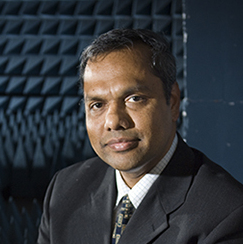
Talk Title: Wireless Sensing Technologies for Internet of Things (IoT) in Post COVID Era
Abstract: RFID, microwave and millimetre wave components and systems are the vital elements for emerging Internet of Things (IoT) and 5th Generation (5G) wireless communications. Mass deployment of RFID in IoT is hindered due to the high cost of the tag. Fully printable low-cost chipless RFID and sensors are the potential candidates for IoT and 5G. Adding sensing capability with identification makes the chipless RFID sensor a very interesting proposition for IoT, which needs billions of such sensors each year. To fulfil the vision of IoT and 5G wireless communications, new low-cost ultrawide band (UWB) microwave and mm-wave technologies such as chipless RFID tags and wireless sensors, smart antennas, and UWB transceiver electronics are required. This seminar presents the development of UWB microwave and mm-wave chipless RFID, wireless sensors, RFID reader architecture and signal processing algorithm for detection, denoising and anti-collision. A massive multiple input multiple output (MIMO) mm-wave smart antenna system is developed for compact reader and RFID throughput improvement. These antennas, reader electronics and active and passive design are equally useful for 5G wireless communications.
Short Biography: Dr. Nemai Karmakar graduated with MSc in EE from the University of Saskatchewan, Canada, PhD in ITEE from the University of Queensland, PGDipTHE from Nanyang Technological University (NTU), Singapore and MHEd from Griffith University. He worked as a microwave design engineer at Mitec Ltd., Brisbane and contributed significantly to the development of Optus Mobilesat smart antennas. He taught senior-level courses in electronics, radar, microwave engineering and antenna technology at QUT, NTU, and Monash University. He has been working on collaborative research projects on smart antennas for soil moisture measuring radiometer in L/Ku/K-band downscaling, fully printable chipless RFID sensors for ubiquitous tagging and sensing, wireless power transmission, microwave biomedical imaging and devices, smart antennas for mobile satellite communications, and diagnostics of faulty power equipment. He has many patent applications in chipless RFID and sensors, eight books and more than 350 refereed journal, conference and workshop publications. A/P Karmakar is a graduate member of IEAust and a senior member of IEEE.
| Important Dates |
|---|
| Paper Submission Deadline: |
| Paper Acceptance Notification: |
| Camera Ready Paper Submission: |
| Registration Deadline: |
| Conference Dates: 29–31 January, 2026 |


